
Beyond the Equipment: Creating Outdoor Environments Rich in Possibilities

Walk into an early years conference or browse the catalogue of almost any educational supplier and you could be forgiven for thinking that the secret to an outstanding outdoor environment lies in purchasing the latest equipment. There are climbing structures promising adventure, mud kitchens guaranteeing imaginative play and carefully designed outdoor classrooms that appear to offer endless learning opportunities. For settings looking to improve their provision, it is easy to believe that the next purchase will transform children's experiences.
Yet after spending many years supporting nurseries and preschools to develop their outdoor environments (and before that 20 years working in the EYFS), I have come to a different conclusion.
The most inspiring outdoor spaces I have visited are rarely the ones with the biggest budgets.
In fact, some of the richest learning I have observed has taken place in settings with relatively simple outdoor areas, where children have been given time, freedom and access to resources that encourage them to explore, investigate and make decisions for themselves. Equally, I have visited beautifully equipped outdoor spaces where expensive resources remained largely unchanged from one day to the next, offering children limited opportunities to think creatively or direct their own learning.
The difference is not usually financial. It is philosophical.
The question is not, "What equipment do we need?"
It is, "What opportunities do we want children to experience?"
This distinction may seem subtle, but it fundamentally changes how we think about outdoor provision.

Looking Beyond Equipment
When practitioners begin evaluating their outdoor environment, conversations often focus on what is missing. A new climbing frame, an outdoor stage or a larger mud kitchen quickly find their way onto improvement plans.
There is, of course, nothing inherently wrong with investing in quality resources. Well-designed equipment has an important place within many outdoor environments. The difficulty arises when equipment becomes the focus rather than the experiences we hope children will have.
Children do not learn because a piece of equipment exists.
They learn because they interact with it, adapt it, question it, combine it with other resources and use it in ways adults may never have anticipated.
This is why an expensive fixed structure may sometimes offer fewer learning opportunities than a collection of logs, sticks and loose planks. This types of structures also take up valuable space that could be left open for many more possibiliites.
The resource itself is not what matters most. The possibilities it creates are.
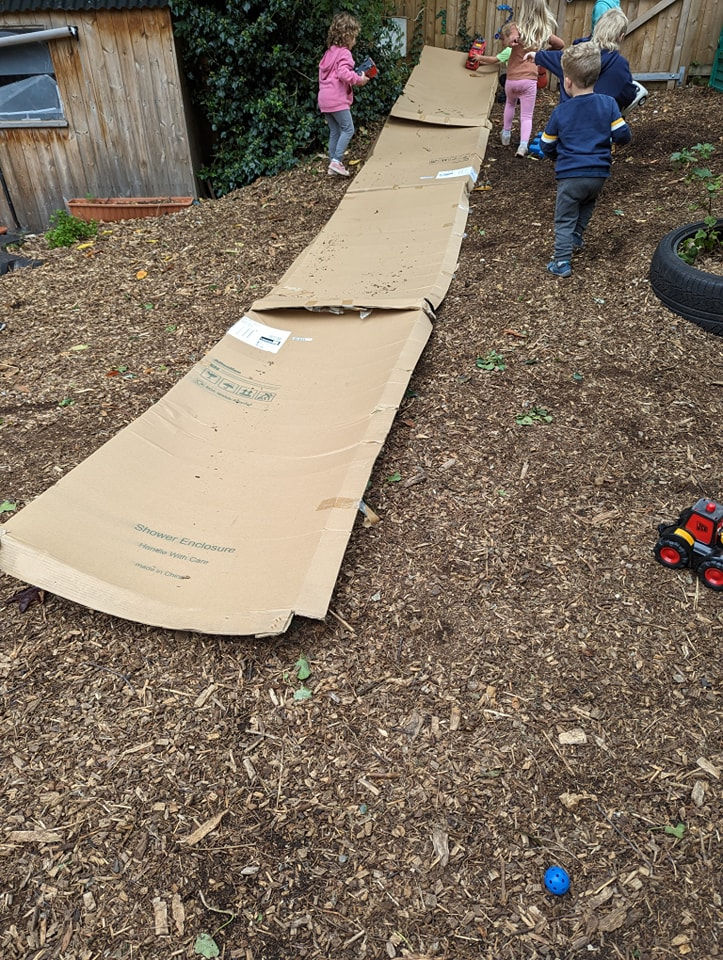
Five Features of Rich Outdoor Provision
Whenever I visit a setting, there are five elements that I hope to find. They are not expensive, and they are not dependent upon the size of the outdoor space. Instead, they reflect the kinds of experiences that support children's development across every area of learning.
1) A genuine connection with nature 🪴
Nature should never become simply a backdrop to outdoor play.
Too often we see a token raised bed or a small sensory planter that fulfils the requirement for "nature" without allowing children to genuinely experience the natural world.
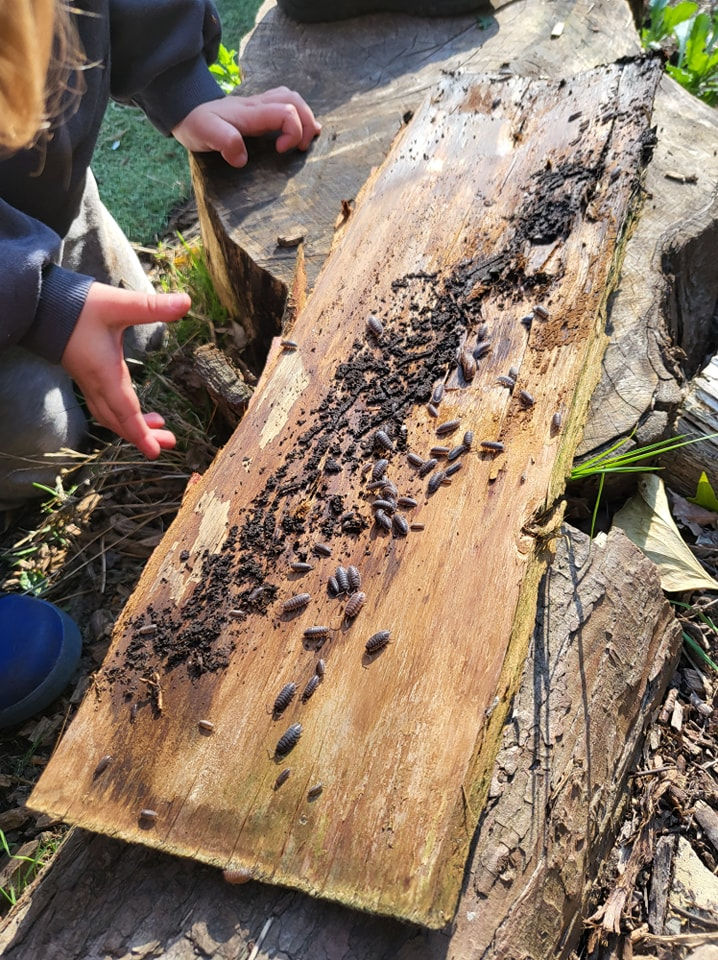
Children deserve opportunities to notice seasonal change, observe wildlife, feel different weather conditions and encounter natural materials in meaningful ways.
The educational value of these experiences is enormous. A child watching a snail cross a path is developing sustained attention. A group investigating why puddles disappear is beginning to construct scientific understanding. Leaves collected from around the garden naturally become resources for sorting, measuring, pattern making and creative expression.
Nature is unique because it never repeats itself. Every day presents different questions, different materials and different possibilities.
This aligns closely with the work of Robin C. Moore, whose research into children's outdoor environments has consistently shown that natural landscapes encourage more imaginative, collaborative and cognitively demanding play than highly structured spaces. Likewise, Tim Gill has argued that children benefit most from environments that offer "managed opportunities" for exploration rather than predetermined outcomes.
2) Loose parts that encourage creativity 🧱
Perhaps no resource demonstrates the difference between equipment and opportunity more effectively than loose parts.
A collection of crates, tyres, logs, fabric, sticks, guttering or wooden planks may appear ordinary to adults. To children, however, they become whatever imagination requires them to be.
A bridge becomes a pirate ship.
Tyres become stepping stones before becoming racing cars.
Fabric transforms into dens, costumes or rivers.
Because loose parts have no predetermined purpose, they encourage flexible thinking, collaboration and problem solving.
Architect Simon Nicholson proposed that creativity flourishes in environments containing variables that children can manipulate. More than fifty years later, his Theory of Loose Parts remains one of the most influential ideas in outdoor learning because practitioners continue to see its impact every day.

3) Opportunities for physical challenge 🪜
Children are biologically designed to move.
Running, climbing, balancing, lifting, pulling and carrying are not simply enjoyable activities; they are essential experiences that support physical development, confidence and resilience.
Importantly, these opportunities do not always require purpose-built equipment.
Transporting logs to build a den may demand greater strength and coordination than climbing a fixed structure.
Walking across uneven ground develops balance in ways perfectly level playgrounds cannot.
Negotiating manageable risks also helps children learn to assess situations, make decisions and build confidence—an area that has been extensively explored by Tim Gill in his work on risk and play.

4) Quiet spaces for observation and reflection ☁️
When discussing outdoor provision, we often focus on active play, yet some of the richest learning happens during moments of stillness.
A sheltered corner beneath a tree.
A bench overlooking the garden.
A space where children can simply sit and watch.
These quieter areas allow children to notice details they might otherwise overlook: ants carrying food, birds gathering nesting material or shadows changing throughout the day.
Such moments nurture curiosity—the starting point for scientific thinking—and remind us that learning is not always noisy or immediately visible.

5) Freedom to choose 💬
Perhaps the most significant feature of all is one that cannot be purchased.
Children need opportunities to make meaningful choices.
The EYFS places considerable emphasis on the characteristics of effective teaching and learning, encouraging children to play and explore, actively engage and think critically.
These characteristics are difficult to develop if every aspect of outdoor learning is directed by adults.
When children decide where to play, which resources to use and how to solve problems, they become active participants in their own learning rather than passive recipients of adult-planned activities.

Nature: The Resource We Too Often Overlook
Ironically, the richest resource available to every setting costs nothing at all. Nature continually presents children with invitations to learn.
A strong wind raises questions about weather and forces.
Frost prompts investigations into melting and change.
A feather sparks conversations about birds.
Rain transforms familiar spaces into entirely new landscapes.
These experiences are impossible to timetable because they emerge unexpectedly. Perhaps that is precisely why they are so powerful.
As practitioners, we sometimes feel pressure to provide an activity every time children go outdoors. Yet many of the most memorable learning experiences begin not with adult planning but with children's observations.
Instead of asking, "What activity shall we set up today?", perhaps we should begin by asking, "What is nature offering us today?"
That single question encourages practitioners to become observers as much as organisers. It reminds us that our role is not always to introduce learning but often to recognise and extend the learning that is already unfolding around us.
Planning for Possibility
None of this suggests that planning is unnecessary or that outdoor provision should be left entirely to chance. Thoughtful planning remains essential.
However, perhaps our planning should focus less on activities and more on creating conditions in which rich learning can emerge.
Are natural materials readily available?
Can children access loose parts independently?
Are there opportunities for manageable risk?
Do children have uninterrupted time outdoors?
Is there somewhere to be physically active and somewhere equally inviting to sit quietly?
These questions may ultimately have a greater impact on children's learning than deciding which new piece of equipment to purchase next.

A Different Measure of Success
When adults reflect on their own childhoods, they rarely describe expensive playground equipment. Instead, they remember climbing trees, building dens, catching tadpoles, splashing through puddles and collecting autumn leaves.
Those memories endure because they were filled with possibility rather than prescription.
Perhaps this is the challenge for us as early years professionals.
Rather than asking whether our outdoor environment looks impressive, we might ask whether it inspires curiosity.
Rather than measuring success by the equipment we have installed, we might measure it by the questions children ask, the problems they solve and the discoveries they make.
Outstanding outdoor provision is not created by what we buy.
It is created by the opportunities we intentionally provide—and by recognising that the most extraordinary resource we have has been waiting outside all along.
The next time you're considering spending several thousand pounds on new outdoor equipment, pause for a moment.
Walk outside instead.
Ask yourself:
Can children experience nature here?
Can they move resources?
Can they take appropriate risks?
Can they find somewhere quiet to think?
Can they make meaningful choices?
If the answer to those questions is yes, then you may already have the ingredients of an outstanding outdoor environment.
Because children don't need an outdoor space full of equipment.
They need an outdoor space full of possibilities.


Comments