

Books Shouldn’t Live in Just One Corner 📚
- earlyinsights

- Mar 20
- 4 min read

Walk into many early years settings and you’ll often see the same thing.
The book corner.
A cosy space. A soft rug. A carefully chosen basket of stories.
And those spaces matter. They create calm, comfort, and a place for children to slow down with a book.
But what if books could do more than sit in one corner?
What if they travelled?
When Books Move, Learning Deepens
Books become far more powerful when they are woven throughout the environment—when they become part of play, not separate from it.
A travel magazine or book about bridges or towers placed in the construction area.
A recipe book in the role play kitchen.
A nature guide taken outside with a magnifying glass.
This approach is supported by what we know about how young children learn. In the early years, learning is not compartmentalised—children don’t separate “reading time” from “play time”. Instead, they learn through meaningful, connected experiences.
Research around early literacy consistently shows that children develop stronger engagement with books when they are:
embedded in real-life contexts
linked to their interests
available independently
By allowing books to move through the environment, we create more opportunities for incidental reading behaviours—those small, powerful moments where children choose to engage with print naturally.
Suddenly, books are no longer something children are directed towards.
They become something children choose

Books as Tools for Play and Discovery
When books are embedded into provision, something shifts.
A child building a tower pauses to look at a picture of a real castle.
A group of children cooking in the home corner flick through a recipe book as they play.
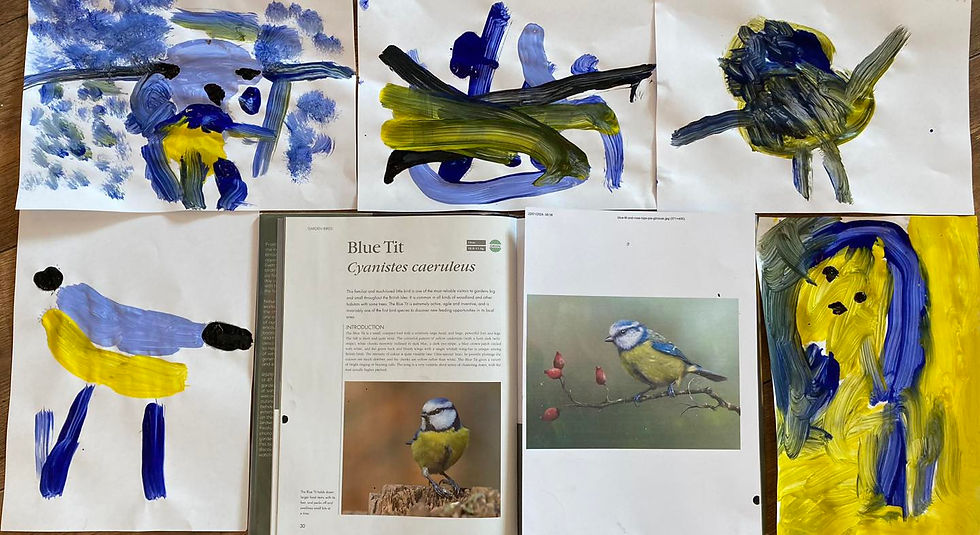
A child outside spots a bird… then searches for it in a book to find out more.
In these moments, books aren’t an “activity”.
They are a tool.
A way to answer questions. To spark ideas. To extend play.
This is where early literacy becomes meaningful—because it has a purpose.
This aligns closely with child-led and play-based learning approaches, where resources are most effective when they extend thinking rather than direct it.
Books can:
introduce new vocabulary in context
provide visual references to deepen understanding
spark imagination and storytelling
support problem-solving and enquiry
This also reflects the idea of sustained shared thinking—where adults and children explore ideas together. A well-placed book can act as a prompt for rich conversations:
"I wonder if our tower could look like that?"
"Shall we try that recipe?"
"What do you think that bird is called?"
Here, literacy is no longer isolated. It becomes part of communication, thinking, and exploration.
Take Books Outside
If we really want to deepen children’s connection with books, we should also think beyond the indoor environment.
Some of the richest reading experiences don’t happen in the book corner at all.
They happen outside.
Reading under a tree.
Turning pages while clouds drift across the sky.
Holding a book next to something you’ve just discovered.
Spotting a bird overhead… then finding it again in a picture.
These moments are powerful because they connect books to the real world.
They make reading feel relevant.
Outdoor learning research highlights the importance of first-hand experiences. When children can directly connect what they see in a book to what they experience in real life, learning becomes more meaningful and memorable.
Books outdoors can:
support curiosity and enquiry
deepen understanding of the natural world
encourage children to revisit and reflect on experiences
create calm, shared moments in a busy environment
There is also something powerful about the shift in atmosphere. Outdoors, reading often becomes more relaxed, less formal, and more exploratory.
It’s not about sitting still.
It’s about noticing, wondering, and connecting.

Building a Relationship with Books
When books are everywhere, children begin to see them differently.
Not as something they are told to do. Not as a task or expectation.
But as something that naturally belongs in their play.
Something that helps them explore, imagine, and understand.
And that’s what really matters.
Research into reading for pleasure tells us that positive early experiences with books are one of the strongest predictors of later reading engagement.
Children who see books as:
enjoyable
useful
meaningful
are far more likely to choose to read as they grow older.
This is especially important in the early years, where the goal is not just decoding words, but developing:
curiosity
imagination
language
a sense of identity as a reader
By embedding books into everyday experiences, we move away from a “reading time” model and towards a reading culture.
One where books are part of life.

A Simple Shift with Big Impact
This isn’t about removing the book corner.
It’s about expanding it.
Small, thoughtful changes can make a big difference:
placing relevant books in each area of provision
rotating books based on children’s interests
taking books outside regularly
modelling how books can be used during play
This approach also aligns with effective early years practice, where environments are:
language-rich
responsive
carefully planned but flexible
Books don’t need to be preserved on a shelf.
They need to be used.
Handled. Explored. Revisited.
Sometimes even a little worn.
Because that’s how children show us they matter.
Books shouldn’t live in just one corner of the room.
They should live wherever children are.

Comments