

Early Writing and Mark Making
- earlyinsights

- Jul 18, 2025
- 4 min read
What is Mark Making and how does it develop?
Mark making is a term used for the creation of different patterns, lines, textures and shapes. This may be on a piece of paper, on the floor, outside in the garden or on an object or surface.
It could be a simple dot or a line across a paper, all of this contributes to mark making and fundamentally is the basis of developing writing skill.
Children are born with a natural exploratory drive and desire to communicate their thoughts and feelings. From the moment of birth, they strive to make sense of their world and quickly reveal their unique characteristics as their personalities, preferences and different developmental pathways unfold. Through their play, young children explore imaginary and abstract worlds, making meaning through story making, mark making and drawing. As their ideas develop, they often create increasingly elaborate versions of their understanding of the world around them.
In an emotionally secure environment, where their creativity is valued and respected, children will often become prolific mark makers. This is particularly true when the purpose and the means of representation are within their control.
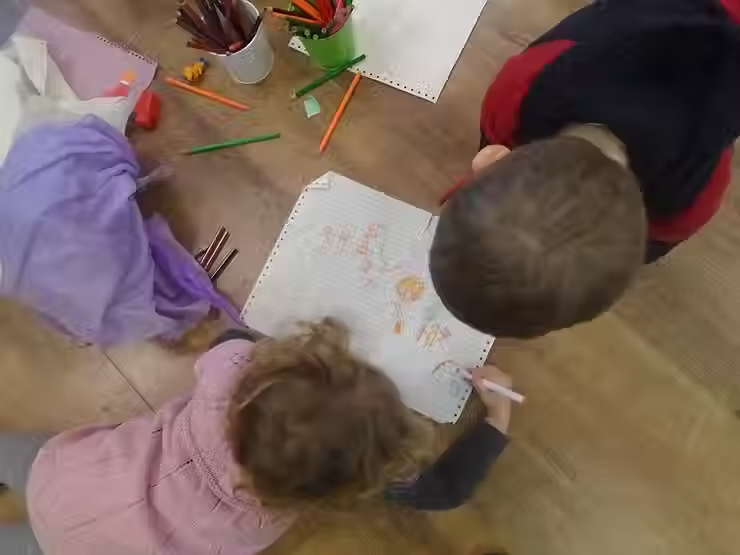
To be able to control fine muscles, young children need to develop the larger muscles in their body. So create opportunities for crawling, lateral rolling, jumping, running, hopping, skipping, climbing, hanging from a bar, pushing and pulling. It’s really important for young children to develop core strength. Babies “coordinate their arm muscles from the shoulder, then the elbows and then the wrists. Skilful manipulation of the fingers or fine motor skills, comes last” (Meyerhoff, 2013). Children need to have strength and control over at least 25 different muscles to be able to write a word! What this means is their are many many stages and developments that take place before a child can write their first word. They will begin with scribbling and exploring the relationship between movements and the marks that are left. At the age of 3 - 4 years old children begin to make marks for meaning, which are usually for writing and drawing. They are starting to make connection between print and drawing within the environment and the fact that symbols they see, carry meaning. Even though their marks making often bears no resemblance to print, they are gaining more control over their muscles and the direction they want their marks to go. They can often tell you about the marks they make.
The next step is to link this writing skill with understanding that letters and numbers have meaning. As children start school if they have an enjoyment of mark making and have lots of experience of making marks in different ways they will be in the perfect position to continue their development.
How should it be supported and encouraged in Early Years Settings?
Mark Making is seen as equally important to every other type of learning and play and teachers are on hand to support and teach. The environment is also an important teacher. The environment has numbers, letters and writing displayed around the walls and mark making materials can be found inside and outside. These facts alongside a focus on being child led means that children can choose to make marks when and where they want to. Children at this age learn best when they are enjoying themselves and they have choices about what they are doing and where they are doing it.
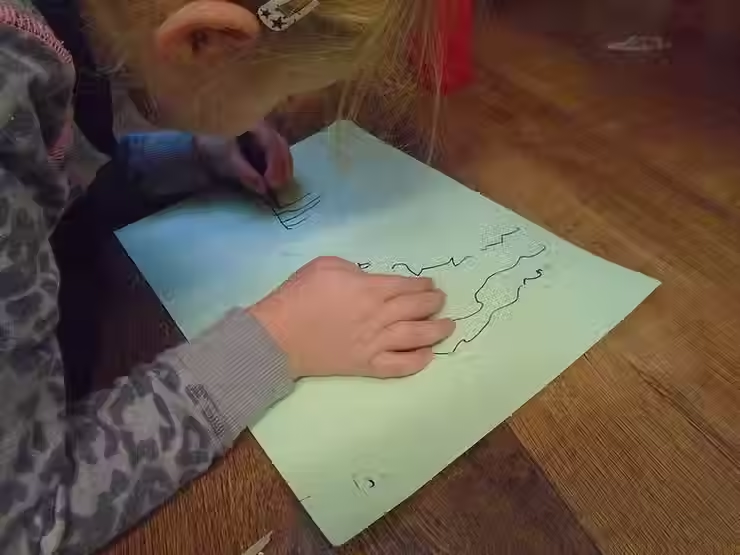
Inside and Outside
At Busy Bodies we recognise that some children prefer to be outside and some prefer to be inside and some children enjoy a mixture of both. This can depend on the time of day, weather, who they are playing with, how hungry they are, etc, etc. We have a free flow approach which means during work time the door is open to the outside area with teachers located in all areas. Children can therefore learn, develop and play inside and outside and as their games change and develop they can move from one environment to the next. The outside area does allow for different opportunities, bigger movements, more climbing and running but mark making and writing are still available. We have clipboards, chalkboards, paint brushes, mud, sand and much more that can be used for mark making and play.
Supporting individual differences
When you have a wide age range of resources available it means that even though the children are developmentally at different stages and are unique individuals they can be supported. This means that you can not have a one size fits all approach to subjects like mark making as each child will be more or less engaged depending on a variety of different things (location, who the teacher is, materials available, what the subject is). I find the best approach is to focus on the environment and teachers. The environment has been created in order for children to feel comfortable, safe, secure whilst also encouraging curiosity and working together.
Experienced, caring and focused teachers are aware of each child's individual development, interests and can use their knowledge and experience to support children.

I have a clear philosophy that is focused on being led by the children and allowing them to explore and develop in their own unique way.
Instead of focusing on teacher led activities you should instead focus on creating an environment that supports socialising, learning, curiosity and well-being. You should create an environment that allows all children the opportunity to explore a range of resources, materials and games. You should aim to create an environment where children will have many different ways of representing their thoughts and feelings. Some will choose music, dance or song, others will prefer to tell stories through role-play, drama or using small world resources, but some may choose mark making.
So in conclusion every day you will see lots of opportunity for children to be making marks and developing their early writing skills. You do not need pencil control sheets (unless the child asks for one) or adult led mandatory writing activities but instead focus on:
Creating and maintaining an environment indoors and outdoors that allows mark making to take place in as many different forms as possible.
Understand the children and engage in their activities and games.
Role Play mark making, making lists, drawing different pictures, writing and encourage a love of art.


Comments